
Interview with Francesco Todaro, Of Counsel – Special Situations, Bacciardi Partners – By Simona Pistola
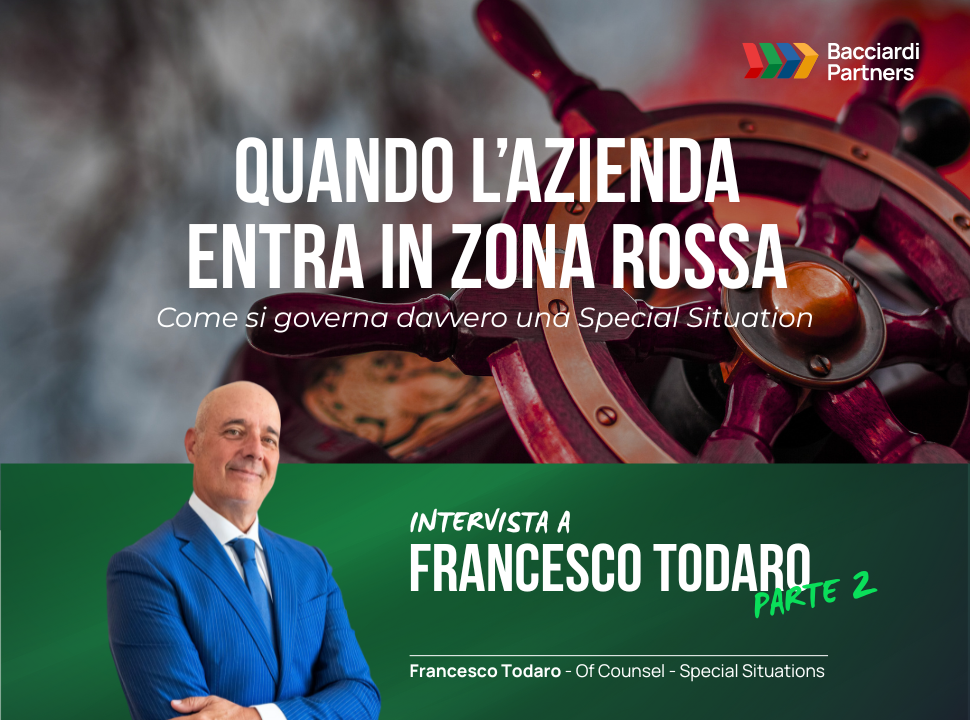 For a company, finding itself in a Special Situation means entering a phase in which operational, financial or strategic tensions begin to interact, generating effects that change the company’s direction even before a crisis openly materializes.
In this interview, Dr. Francesco Todaro – Of Counsel Special Situations at Bacciardi Partners – walks through the dynamics that characterize these critical moments, explaining how to recognize the signals that truly matter and which decisions allow management to retain control when pressure increases.
This is where the work of the Bacciardi Partners team is rooted: a concrete multidisciplinarity that integrates different competences and makes it possible to intervene coherently and promptly, before the situation turns into an emergency.
1. In Special Situations, which competences must act together to protect continuity and value?
“Special Situations cannot be governed through a single discipline. When a company comes under strain, the issue is not where the problem originates, but how industry, finance, strategy and law combine. If one of these levers does not move, the operation does not hold.
The truly effective approach is one that stands beside the entrepreneur. Not above, not in front: beside. It is a shared journey, often involving difficult choices, because when the situation stiffens it takes courage to cut habits, relationships and procedures that worked for years but now anchor the company.
That is why we often say we ‘come aboard’ the same vessel. It is not a comfortable environment: the sea can change quickly. But those who work in this field are accustomed to operating under stress. Serenity does not come from recklessness, but from mastery of the tools.”
2. What distinguishes a manageable signal from one that is already turning into a crisis?
“Early diagnosis is the real discriminator. The earlier you detect the signal, the more options you have. When we arrive late, the room for maneuver shrinks; when we arrive at the right moment, we can still reorient the course in an orderly way, avoiding traumatic interventions.
The new Crisis Code makes this clear: companies that activate timely instruments exit the crisis in an orderly manner. This means that crisis is not the end point, but a phase to be governed.
This is the role of the advisor: to read weak signals when the entrepreneur is absorbed by daily operations. It is like in emergency care: those who are prepared remain lucid because they know which moves to make, and in which order.”
3. Which directions of change are emerging today for Italian companies?
“There are three main vectors: sustainability, supply chains and technology.
Sustainability has become an industrial requirement, no longer a reputational theme. Supply chains are introducing very strict selection criteria, and those who do not align risk exclusion.
The second axis is the supply chain: today it is the most vulnerable point and, at the same time, the one that most determines operational continuity.
The third is technology. I am not referring only to investment, but to digital culture. Many organizations do not realize how far behind they are. Change is rapid, and this speed creates stress. Those who ignore it fail to see that the gap widens every day.”
4. What is the most frequent mistake entrepreneurs make when operational or financial tensions emerge?
“The most common mistake is cutting the wrong things. Under stress, the instinct is to reduce what is perceived as ‘non-essential’: often personnel, communication or the commercial network. But these are vital levers.
The second mistake is acting on prices: lowering them to recover volume, when margin is the real issue, simply generates more losses.
The third mistake is confusing a payment extension with a solution. When a supplier accepts longer payment terms, it is not rewarding the company: it is signaling risk. It is an alarm, not a concession.
Then there is the most dangerous signal: delayed salary payments. That is DEFCON 3. It is not yet a crisis: it is advanced pre-crisis.”
5. What immediate actions should a company take when it perceives the first signs of stress?
“The first is to safeguard liquidity. Always.
The second is to protect margin: without margin, volume saves no one.
The third is to restore order in decision-making processes, because clarity dissipates under tension.
These are three quick but decisive actions. Then the rest can be built.”
6. Which industrial, financial or legal tools are most effective today in addressing a Special Situation?
“The most effective tool, before any technicalities, is to place a competent person in charge of the crisis. Not an administrator, not a salesperson, not a technician: someone with specific experience in emergency management.
Then come the instruments: industrial, when margins must be recovered and processes redesigned; financial, when relations with banks and stakeholders need stabilization; legal, when a procedure, negotiation, due diligence or extraordinary transaction must be structured. None of these tools works alone. They work only if coordinated.”
7. What distinguishes an effective turnaround from a late or ineffective one?
“Speed. The difference lies not in technical sophistication but in timing. If you intervene early, you can reshape the model, rebuild trust, and negotiate with clarity. If you intervene late, you merely contain damage.
Turnaround is not the management of an accident: it is the ability to prevent the accident from happening.”
8. What specific value does Bacciardi Partners bring to the management of Special Situations?
“The ability to bring together all necessary competences: industrial, financial, tax, legal, corporate and negotiation. A Special Situation is a cross-cutting phenomenon, and it requires teams capable of operating across multiple dimensions without losing coherence.
This is the added value: real multidisciplinarity, not proclaimed. Companies do not need a single specialist; they need a control room. And we know how to build that control room.”
Bacciardi Partners is available to support entrepreneurs and management in the early identification of warning signs, in managing phases of discontinuity, and in defining timely and sustainable intervention paths.
Contact us to jointly assess your company’s situation and the possible actions to take.