
 In people management, companies are frequently required to make decisions under pressure: an unexpected deadline, an organizational issue, or a regulation that must be implemented at short notice. In these situations, the real risk is not only the possibility of error, but also the adoption of choices that appear effective in the short term while generating complications over time, such as increasing personnel costs, organizational rigidity, or the need for repeated revisions of previously taken decisions.
It is precisely from this practical need that the partnership between Bacciardi Partners and Macrelli e Bartolini Associati was established. The objective is to support companies starting from their organizational framework – roles, responsibilities, structure, governance, and decision-making processes – and then moving coherently toward regulatory management and compliance. This approach moves beyond a purely reactive, emergency-driven logic: compliance is not treated as the starting point, but as the natural outcome of a more robust organizational setup.
The distinctive value of the collaboration lies in the integration of the respective areas of expertise of the two organizations. Addressing organizational design, labor consultancy, and legal assistance in isolation often results in fragmented solutions that require continuous adjustments. Working within an integrated team, by contrast, allows for a joint assessment of organizational, economic, and regulatory impacts, reducing the risk of inconsistent decisions and enhancing their stability over time.
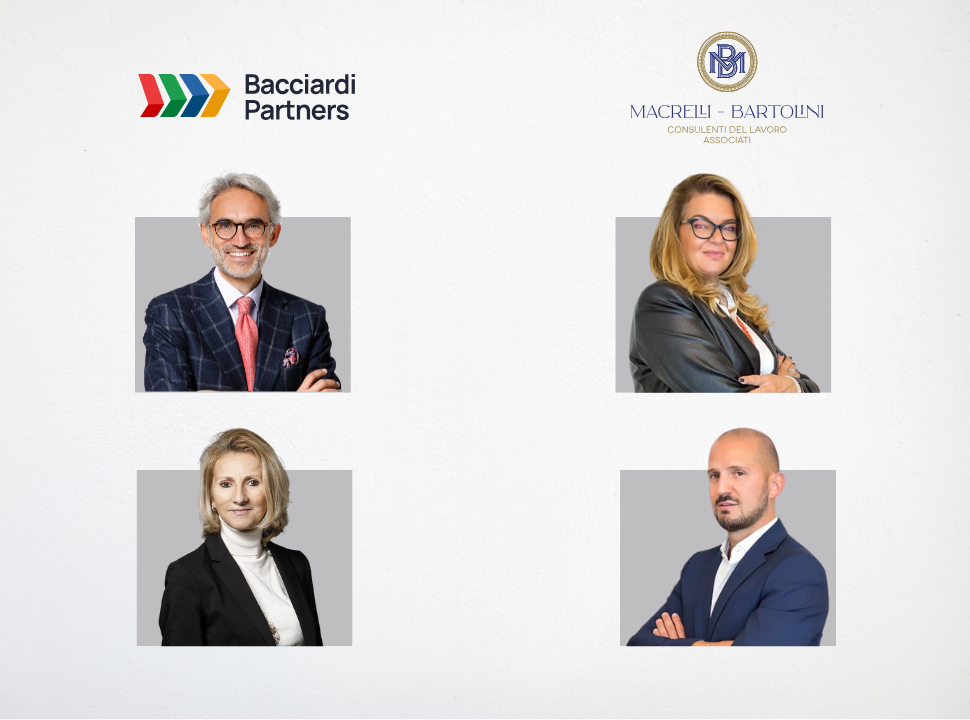
“Today, the quality of decisions relating to people directly influences the stability and development of a business,” explain Lorenzo Bacciardi and Antonella Lanzani, CEO and Head of Organization & People at Bacciardi Partners. “This partnership is designed to provide a method that combines strategic vision with operational effectiveness, enabling companies to make decisions with greater clarity and consistency.”
A significant portion of the integrated team’s work will focus on supporting companies through the changes that will affect remuneration systems in the coming years. In particular, this includes preparing for the new European pay transparency rules, which will require greater clarity, coherence, and traceability in compensation policies. This transformation goes beyond mere compliance: it reshapes how roles, career paths, and remuneration criteria are designed, making a close alignment between organizational structure, HR choices, and the application of labor regulations increasingly essential.
“In a market characterized by persistent demographic decline, where people have become the ‘new gold’, formal correctness is no longer sufficient,” state Romina Macrelli and Paolo Bartolini. “The EU Pay Transparency Directive moves precisely in this direction, making inequities arising from haste and emergency increasingly visible and less sustainable. For companies, it is crucial to govern this change rather than be overwhelmed by it: this is why an integrated approach combining labor consultancy and strategic organizational design is indispensable. Only by bringing these competencies together can corporate governance be preserved, preventing uncontrolled cost escalation and a decline in employee motivation.”
The partnership positions itself as a stable support for enterprises. It enables them to govern people, organization, and rules through a unified approach. It reduces improvisation and strengthens decision-making confidence.